If an old hot tub cover becomes unusually heavy, the common explanation is that the foam has become “waterlogged” and has therefore lost all of its insulation value.
The first part can certainly be true. The second is not.
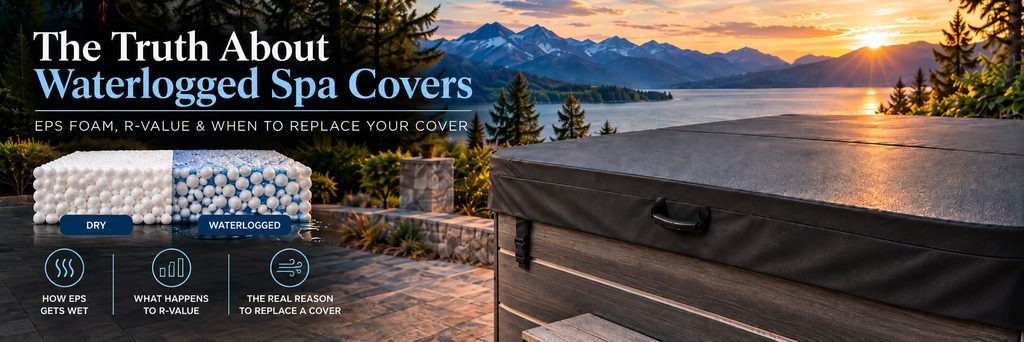
Expanded polystyrene, or EPS, does absorb moisture under the right conditions, and that moisture reduces its insulating performance. But EPS does not suddenly change from an effective insulation material into something with zero R-value.
Understanding why requires looking at how EPS is actually made, where the water goes, and how a spa cover really loses heat.
What Is EPS Foam?
EPS is the rigid foam commonly used inside traditional hot tub and spa covers. It is manufactured from small polystyrene beads that are expanded and then fused together into a larger block.
Each expanded bead contains thousands of tiny closed cells filled primarily with gas. Those trapped gases are a major reason EPS is a good insulator.
But there is an important distinction between the closed cells inside each bead and the small spaces and channels between neighboring beads.
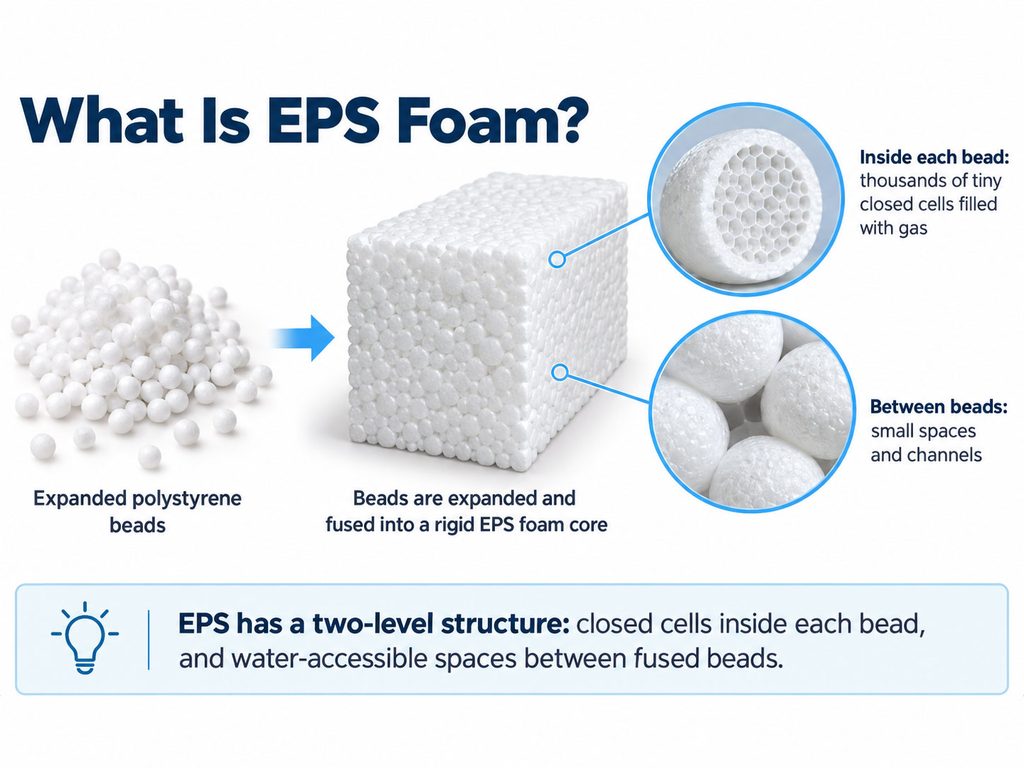
Research describing the microscopic structure of EPS identifies exactly this two-level structure: closed cellular foam within the individual beads plus water-accessible spaces between fused beads.
That distinction explains much of what happens inside an aging spa cover.
If EPS Is Closed-Cell Foam, How Does It Become Waterlogged?
Calling EPS “closed-cell” does not mean that an entire EPS board is one completely waterproof mass.
The individual expanded beads are predominantly closed-cell. However, the molding process can leave interconnected microscopic spaces between those beads. Liquid water can occupy some of those spaces when moisture reaches an unprotected EPS core.
Water vapor is somewhat different.
It would be inaccurate to say that vapor can never penetrate the closed cellular structure. Scientific literature on polystyrene insulation indicates that vapor diffusion through the polymer and closed-cell structure is possible, but it occurs much more slowly than moisture movement through the interconnected spaces between EPS beads.
So the simplified picture is:
- Most rapid moisture movement occurs through spaces between fused EPS beads.
- The gas-filled cells inside the beads remain much more resistant to liquid-water penetration.
- Water vapor can diffuse through polystyrene, but this is comparatively slow.
This is why an EPS core can take on a surprising amount of weight without every microscopic insulating cell literally filling with water.
Why Do Hot Tub Cover Cores Get Wet?
A spa cover operates in a difficult environment.
One side may be exposed to rain, snow, sunlight and temperature swings. The other sits above hot water that continuously produces warm, humid air.
For that reason, a conventional EPS spa cover core is normally protected by a plastic vapor barrier or moisture-resistant envelope. Spa cover designs documented for decades have used sealed films around the foam specifically to limit moisture reaching the insulating core.
As that barrier ages, seams can weaken, films can develop holes or cracks, and moisture can gain easier access to the foam.
Once moisture reaches the EPS, the network of spaces between beads gives it somewhere to go.
That produces the classic symptom spa owners recognize immediately:
The cover gets heavy.
Water weighs dramatically more than the air it replaces, so even a relatively small percentage of water by volume can add substantial weight to a large spa cover.
Does Waterlogged EPS Lose All of Its R-Value?
No.
That is one of the most persistent misconceptions about aging spa covers.
R-value measures resistance to conductive heat flow. At a given thickness, higher thermal conductivity means lower R-value.
When water replaces some of the gas in and around an insulating structure, thermal conductivity increases because water conducts heat much more effectively than still air.
So wet EPS does insulate worse than dry EPS.
But worse is not the same thing as zero.
Published EPS data demonstrate a progressive decline in thermal performance as moisture content rises rather than an instantaneous loss of insulation.
For example, one industry technical reference based on ISO thermal-design methods lists an EPS product with a dry thermal conductivity of approximately 0.036 W/m·K. At 10% moisture content, the listed value rises to approximately 0.054 W/m·K; at 15% moisture, it rises to about 0.066 W/m·K. Because R-value is inversely related to thermal conductivity for the same thickness, those numbers represent meaningful—but certainly not total—losses in thermal resistance.
A broader scientific review likewise reports EPS increasing from approximately 0.037 W/m·K dry to 0.051 W/m·K under the saturated condition examined. Again, insulation performance declined substantially, but it did not disappear.
The important lesson is that there is no scientifically defensible rule saying:
“A waterlogged spa cover loses all of its R-value.”
There is not even one universal percentage of R-value loss. The result depends on the foam, its density, moisture level, temperature and exposure conditions.
Why Can a Heavy Cover Still Contain a Lot of Trapped Air?
This is where the physical structure of EPS matters.
The expanded beads themselves contain large numbers of gas-filled cells. Water entering the spaces between those beads does not automatically displace all of that trapped gas.
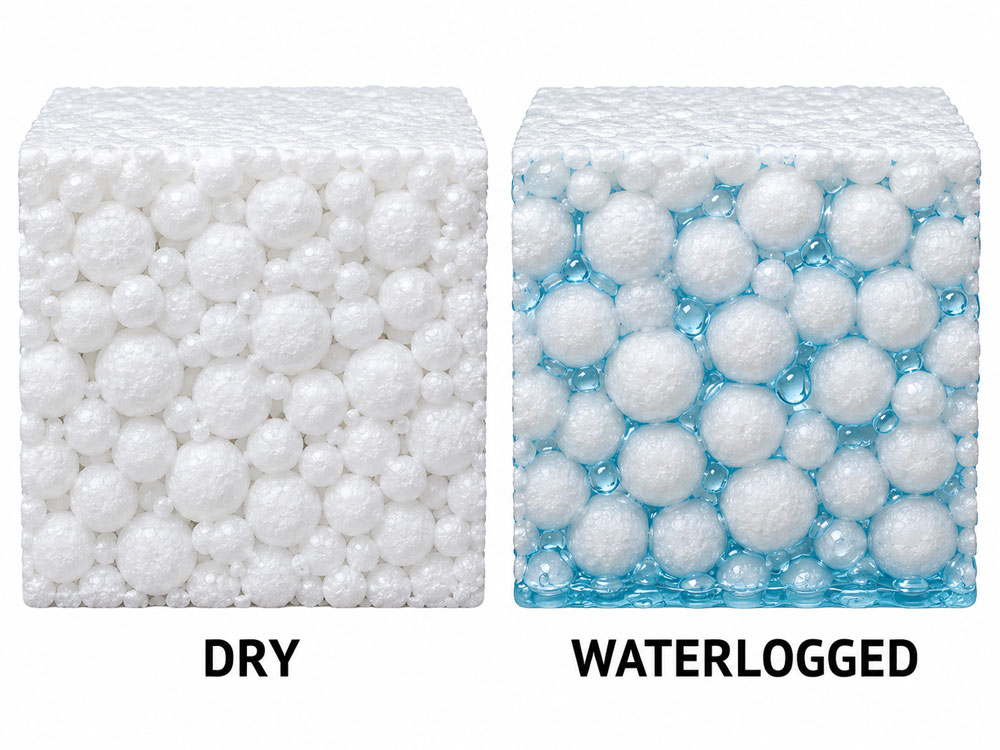
Laboratory investigations of EPS water absorption have observed substantial moisture in the spaces surrounding or separating beads while much of the closed cellular structure remains intact.
That remaining trapped gas continues to provide thermal resistance.
The cover may therefore be:
Much heavier, somewhat less insulating, and still far from having an R-value of zero.
Those three things can all be true at the same time.
R-Value Is Only Part of How a Spa Cover Saves Energy
This may be the most important point for hot tub owners.
A spa cover is not simply a slab of insulation.
It is a complete thermal system.
Heat can leave a hot tub through several mechanisms, including conduction, convection, evaporation and radiation. A properly fitted cover helps control several of those mechanisms at once.
R-value primarily describes resistance to conduction through the cover material.
It does not tell you how effectively the entire cover seals against the spa.
That means an older cover can still have considerable insulation remaining in its EPS core and yet perform poorly because it no longer sits correctly on the tub.
A warped edge, damaged hinge area, sagging section or poor fit can create pathways for warm humid air to escape and cooler outside air to enter.
Those gaps also make it easier for evaporation to contribute to heat loss.
This is why judging an old cover strictly by the theoretical R-value of its foam misses part of the problem.
The Cover-to-Spa Seal Matters More Than Many People Realize
Imagine two covers made from identical EPS.
One lies flat and makes good contact around the spa perimeter.
The other has curled corners and a gap along one side.
Their foam may have essentially the same laboratory R-value, yet they will not necessarily deliver the same real-world energy performance.
The second cover permits additional heat and mass transfer around its edges instead of forcing heat to travel through the insulation.
That distinction is also reflected in how portable-spa energy efficiency is evaluated.
The U.S. Department of Energy’s test procedure measures standby loss for the complete portable spa with its cover installed. California likewise requires specified spa-and-cover combinations when evaluating portable-spa efficiency. In other words, real-world energy performance is treated as a system characteristic—not simply the published R-value of a piece of foam.
So Why Should an Old Spa Cover Be Replaced?
A cover should not be replaced merely because someone declares that EPS “stops insulating” after a certain number of years.
There are better reasons.
1. The Cover No Longer Seals Properly
If the cover has warped, sagged or changed shape enough to leave visible gaps around the spa, heat can bypass the insulated core.
A good replacement restores both insulation and proper fit.
2. The Cover Has Become Excessively Heavy
A major increase in weight indicates that moisture has entered the cover assembly.
Even though the EPS still retains some insulating ability, additional moisture reduces thermal performance and makes the cover increasingly difficult to handle.
3. The Vapor Barrier Has Failed
Once the protective barrier surrounding the EPS has been compromised, the foam is continually exposed to a warm, humid environment.
That condition rarely improves with age.
4. The Core Is Sagging, Cracked or Structurally Damaged
A broken or deformed foam core may no longer maintain the shape necessary to shed water or sit evenly on the spa.
Structural deterioration can therefore become a thermal-performance problem as well as a usability problem.
5. The Hinge or Perimeter Has Deteriorated
The center hinge and perimeter are critical parts of the thermal envelope.
Damage in these areas can create direct paths for warm air and moisture to escape.
6. The Cover No Longer Fits the Spa
Even an otherwise good insulating material cannot perform its job properly if the finished cover is the wrong size or shape.
That is one reason a precisely measured replacement cover matters.
What Is the Real Purpose of a Replacement Spa Cover?
The goal is not simply to replace “old foam.”
It is to restore the entire protective barrier over the hot tub.
A quality replacement spa cover should provide:
- sufficient insulation to slow conductive heat loss,
- an effective moisture barrier protecting the foam core,
- a close custom fit around the spa,
- strong construction that maintains its shape,
- a well-designed hinge and perimeter,
- protection from weather and debris, and
- manageable weight for everyday use.
That complete-system approach is more useful than focusing on R-value alone.
Does Foam Density Matter?
Yes, although density should not be confused with thickness.
EPS density affects properties such as strength and water absorption behavior, while foam thickness directly affects the amount of thermal resistance available through the cover.
Research on EPS has repeatedly shown that moisture absorption behavior changes with density. Lower-density specimens generally provide more available interconnected space for moisture than denser EPS formulations.
For a spa cover, density therefore contributes not just to insulation characteristics but also to structural durability.
The best choice depends on the size of the cover, expected snow or weather conditions, desired strength and overall cover design.
Is a Heavier Waterlogged Cover Automatically a Better Insulator Than It Feels?
No.
The point is not that waterlogging is harmless.
Water inside an EPS core is undesirable.
It adds weight. It raises thermal conductivity. It places additional stress on the cover and hardware. And its presence usually indicates that the moisture-protection system has already been compromised.
The important distinction is simply that waterlogging causes a reduction in R-value, not the instantaneous destruction of all R-value.
That is a much more accurate description of the material science.
The Bottom Line
EPS works as insulation because of the enormous amount of gas trapped within its cellular structure.
When a spa cover’s vapor barrier fails, moisture can migrate into the interconnected spaces between its fused EPS beads. Some slower vapor diffusion into the cellular structure is also possible.
As moisture content rises, thermal conductivity rises and R-value falls—but it does not fall to zero.
And when an aging spa cover stops performing well, the condition of the foam is only part of the equation.
Fit matters. Sealing matters. Structural integrity matters. Vapor-barrier integrity matters.
A cover that no longer seals correctly can allow heat to bypass the insulation through air movement and evaporation even while the EPS itself still retains meaningful thermal resistance.
That is why the best time to replace a spa cover is not based on an arbitrary age or the myth that EPS suddenly “loses its R-value.”
Replace it when the cover as a system can no longer do its job: insulating the water, sealing the spa, resisting moisture, maintaining its structure and remaining safe and manageable to use.
At SPA-MART, we believe a replacement spa cover should be evaluated as a complete thermal system. Proper foam thickness and density are important, but so are accurate measurements, a close custom fit, moisture protection and durable construction. Together, those details determine how effectively a cover protects your spa—and your energy bill—for years to come.